This Tsavo safari birding checklist is built for the field, not the bookshelf. It starts with the more than 500 species recorded across Tsavo East and Tsavo West and narrows them to 50 species you can realistically look for. The goal is a paper you can hold on a bouncing game drive. Pair it with our full Tsavo safari guide if you still need to plan routes and lodges.
Tsavo East and Tsavo West share one park system, but the birding changes with the ground. East is open, dry and hot except for the Galana River, Aruba Dam and the Yatta Plateau. West has Mzima Springs, Lake Jipe and volcanic slopes that rise toward the Chyulu Hills and Taita Hills. A checklist that ignores that split will fail you by the third drive.
Tsavo Safari Birding Checklist: What Birds Can I See in Tsavo National Park?
Start with a short target list: Vulturine Guineafowl, Somali Ostrich, Golden-breasted Starling, Fischer’s Starling, Kori Bustard, Martial Eagle, Lappet-faced Vulture, African Skimmer, Southern Ground Hornbill, Shelley’s Starling, Taita Fiscal, and African Finfoot. Tsavo has more than 500 recorded bird species, so habitat-based targets are more useful than trying to memorize every name.
The rest of this post turns those starting points into a working field checklist. Use the locations as clues, not guarantees.
Tsavo East Birds: A Starter Set of 25
In Tsavo East, open plains and semi-desert scrub cover much of the drive. Cover these early, then slow down when you reach permanent water.
- Vulturine Guineafowl. Dry bush; watch road sides for a large gray flock.
- Somali Ostrich. Open country; look for the blue-gray neck and legs.
- Kori Bustard. Short grass and bare ground, often near termite mounds.
- Secretarybird. Tall grassland hunter; often walks alone.
- Martial Eagle. Large eagle with dark upperparts; often sits on bare limbs.
- Bateleur. Black and silver eagle that banks and rocks in flight.
- Lappet-faced Vulture. Huge scavenger with a bald pink head.
- White-headed Vulture. Its numbers have dropped sharply; record sightings carefully.
- Southern Ground Hornbill. Unmistakable black bird with a red face; usually in pairs.
- Golden-breasted Starling. Blue head with golden underparts.
- Fischer’s Starling. Iridescent back and pale belly in dry acacia country.
- Shelley’s Starling. Glossy dark starling often feeding on open ground.
- Von der Decken’s Hornbill. White-bellied hornbill with a long red-and-yellow bill.
- Red-billed Hornbill. Common roadside hornbill with a thin red bill.
- Eastern Yellow-billed Hornbill. Similar to the red-billed species but with a yellow bill.
- Lilac-breasted Roller. Perches on shrubs and old fenceposts.
- European Roller. Blue-green visitor, present mainly from November to March.
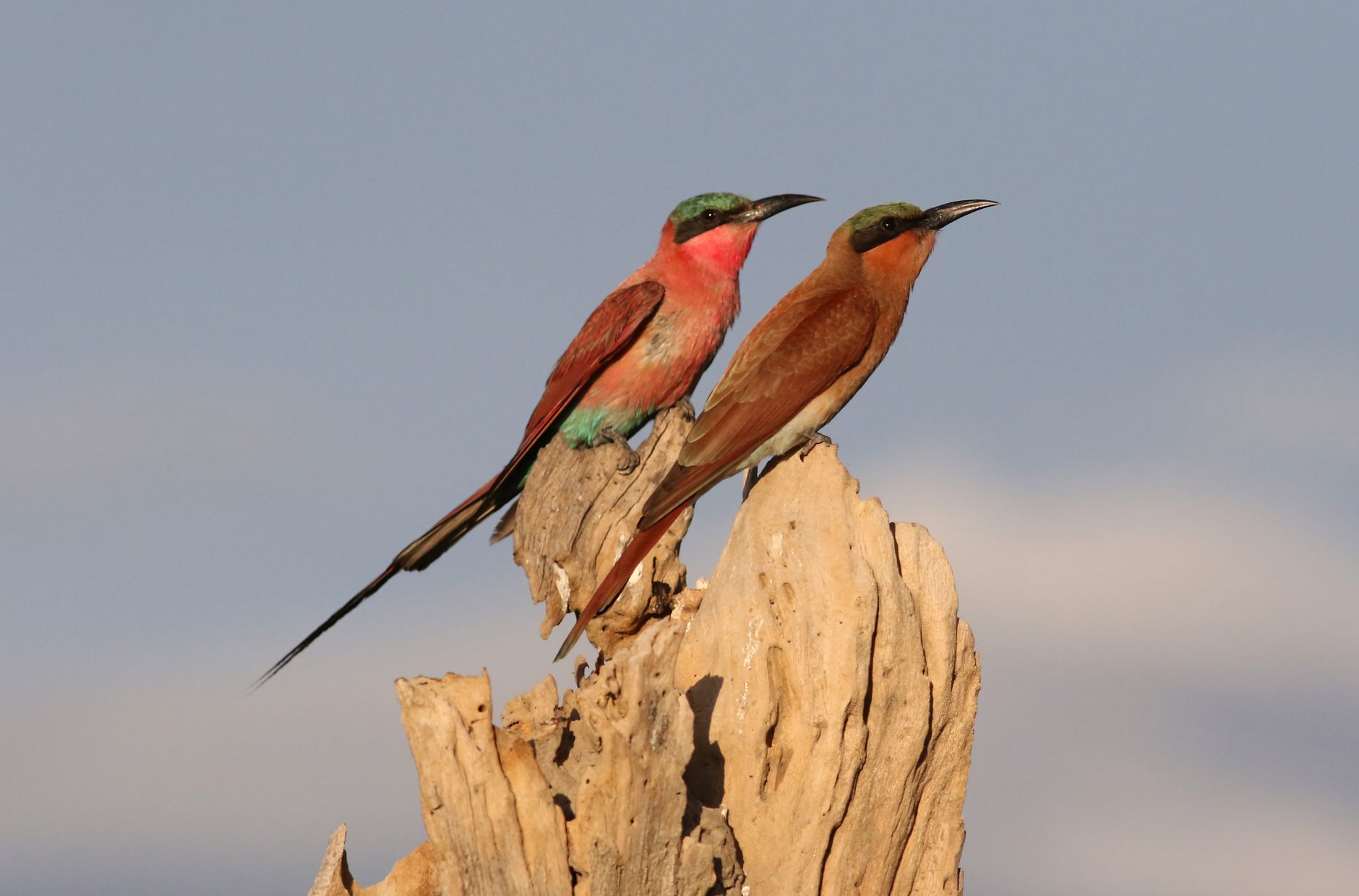
- Northern Carmine Bee-eater. Rose-colored bee-eater; gathers near river sandbars.
- African Skimmer. On the Galana River sandbars; flies low with its lower bill in the water.
- White-headed Buffalo Weaver. Colony nester in thorn trees.
- Red-and-yellow Barbet. Listen for a trilling call in fruiting fig trees.
- D’Arnaud’s Barbet. Small brown and yellow barbet; often sings from roadsides.
- Pygmy Falcon. Tiny white falcon on a dead top branch.
- Taita Fiscal. Black hood and white underparts; perches on low bushes.
- African Hoopoe. Curved bill and tawny body; the crest rises when it lands.
Tsavo West Birds: Springs, Wetlands and Volcanic Slopes
Water changes the list in Tsavo West. Mzima Springs forms spring-fed pools under old fig forest. Lake Jipe adds reed beds and open water. Spend more time looking at the edges.
- African Fish Eagle. Often calls before sunrise.
- African Finfoot. Secretive river bird; scan shaded banks early.
- Giant Kingfisher. Large kingfisher with white spots and a deep rattle.
- Pied Kingfisher. Black and white; hovers over open water.
- Malachite Kingfisher. Tiny bird with a bright blue back and red bill.
- Goliath Heron. Very large heron; stands in shallow water.
- Purple Heron. Prefers to stay hidden in reed stems.
- Hamerkop. Brown bird with a hammer-shaped crest; builds a large stick nest.
- Yellow-billed Stork. White body and red face; sways its open bill through water.
- Saddle-billed Stork. Huge black-and-white stork with a red and yellow bill.
- Marabou Stork. Bald scavenger with a huge wingspan.
- African Sacred Ibis. White ibis with a black head and bill.
- Hadada Ibis. Gray-brown ibis with a loud, far-carrying call.
- Egyptian Goose. Brown body with dark eye patches; pairs on grassy lakeshores.
- Spur-winged Goose. Large goose with white shoulder patches.
- Black-winged Stilt. Slender wader with long pink legs.
- Common Sandpiper. Small wader that bobs its tail constantly.
- Wood Sandpiper. Often feeds alone with a more delicate outline than the common sandpiper.
- African Jacana. Huge feet let it walk on floating plants.
- Long-tailed Cormorant. Dark waterbird that dives and suns with wings open.
- Great White Pelican. White pelican with a pink pouch; groups on open water.
- Pink-backed Pelican. Smaller gray-pink pelican; often roosts in trees.
- White-browed Coucal. Appears on exposed branches after rain; listen for a bubbling call.
- White-bellied Go-away-bird. Gray bird with a tall crest; gives a loud “go-away” call.
- White-eyed Slaty Flycatcher. Dense shrubs near water; listen before you look.
What Is the Best Time for Birding in Tsavo?
Visit from November through April for the best chance of seeing Palearctic migrants, with October also productive as arrivals begin. November-December can bring Amur Falcons, while European Rollers are commonly reported from November to March. The dry season offers easier wildlife visibility and concentrated waterbirds, so birding remains worthwhile year-round.
Plan to be moving by first light. The first two hours after sunrise are usually the busiest for songbirds, and the last two hours before dark are strong for raptors and waterbirds. Midday heat pushes birds into cover, so use that time for a slow lunch or a siesta.
Owls and nightjars are part of Tsavo’s bird life, but night driving is restricted in most Kenyan national parks. Ask your camp what is legal before you expect a guided night search. Our guide to what happens on a Kenya safari at night explains the rules in more detail.
Where Are the Best Bird Watching Spots in Tsavo East and Tsavo West?
In Tsavo East, check Galana River for waterbirds and African Skimmers, Aruba Dam for waders, and Yatta Plateau for raptors and savannah species. In Tsavo West, prioritize Mzima Springs for kingfishers and fish eagles, Lake Jipe for wetland birds, and Ngulia for concentrations of night migrants during misty weather.
For a compact route, start in Tsavo West and bird Mzima Springs and Ngulia first. Cross toward Tsavo East for a full morning around Galana River and Aruba Dam. Lake Jipe is a longer detour but worth it when water levels are good. Ask your driver to pause at habitat transitions: the edge between open plains and riverine woodland is often more productive than either habitat alone.
Some Tsavo itineraries add the Taita Hills forest belt for the threatened Taita thrush. That requires a separate permit and a different habitat from the national park, so ask a specialist operator whether the add-on is realistic. For a wider look at conservation-led wildlife travel, see our Kenya safari conservation experiences in Laikipia.
What Should You Pack for a Birding Safari in Tsavo?
Pack 8×42 or 10×42 binoculars, a compact East African field guide or offline birding app, and a notebook. Add a camera with a long lens, neutral lightweight clothing, a warm layer, a hat, sunglasses, sunscreen, insect repellent, water, and comfortable walking shoes. A pencil checklist is useful because sightings often happen between mammal encounters.
Keep the checklist somewhere you can reach without a big camera change. A small waterproof pouch protects the paper during the wet season. For walking around Mzima Springs, check our Tsavo West packing guide before you leave home.
The basics in our Kenya safari packing list still apply. Add a dry bag for rain, a headlamp for camp, and a reusable bottle. Birds do not wait while you search for gear.
Find a Tsavo Birding Safari That Fits
A good birding safari depends on early departures, patient guiding and lodges that do not rush the schedule. Browse packages with FindMySafari, compare operators through Valley Safaris, or check Trunktrails Safaris for itinerary ideas. Let the operator handle the logistics while you keep your eyes on the trees and water.
More safari planning resources
- Tsavo East and West map from SafariPure
- Kenya wildlife tours from Trunktrails Safaris
- Map of Tsavo from Valley Safaris
- Tsavo destination guide on FindMySafari